You revise vocabulary; what is examined is register
Saying „Hypertonie“ to a patient instead of „Bluthochdruck“ is exactly what gets noticed in the room. The report marks those moments, with the sentence you actually said.
AI simulations with patient interviews, medical letters and case presentations. €79 for 12 months from the purchase date. One-time payment, no subscription
Offer until 7 November, then €149
5 minutes free. See your result immediately and get detailed feedback by email.
Guten Tag, Herr Weber. Seit wann haben Sie diese Schmerzen, und wo genau spüren Sie sie?
Seit heute Morgen. Hier auf der Brust, wie ein starker Druck. Manchmal zieht es in den linken Arm.
Ich stelle Ihnen Herrn Weber vor, einen achtundfünfzigjährigen Patienten mit drückenden Thoraxschmerzen seit heute Morgen und Ausstrahlung in den linken Arm. Eine arterielle Hypertonie ist bekannt. Es besteht der Verdacht auf ein akutes Koronarsyndrom.
Nehmen Sie regelmäßig Medikamente ein, Herr Weber? Haben Sie Allergien?
Ja, morgens nehme ich Ramipril gegen meinen Bluthochdruck. Gegen Penicillin bin ich allergisch. Davon bekomme ich einen Hautausschlag.
Saying „Hypertonie“ to a patient instead of „Bluthochdruck“ is exactly what gets noticed in the room. The report marks those moments, with the sentence you actually said.
A colleague says it went well. The report says which critical checklist item was missing and at which minute the history-taking went off the rails.
Presenting to the senior doctor and defending the case against objections is its own block with its own criteria. Here it is practised as one.
How it runs
The simulation runs in one sitting. The timer runs on the server, you get a warning 60 seconds before the end, then the block moves on. One pause of up to five minutes per block is possible: the real exam has none, and the interface tells you so.
The width of each block is its length: 60 minutes in one sitting, the timer runs on the server and the switch between blocks is automatic.
01
An AI patient with a personality and everyday speech. Some facts come out unprompted, others only if you ask, and one only appears if you probe with empathy. He asks his own questions: „Ist das was Schlimmes, Herr Doktor?“, and it is noticed when you do not answer. You can interrupt him like a real person.
02
Document the case in five clear sections, then compare your text with the case model letter. Choose your medical chamber to see its documentation format.
03
You present the case. The senior doctor speaks in a formal register, interrupts if your presentation runs past three minutes, and always raises at least two objections, for instance: „Warum schließen Sie eine Lungenembolie aus?“
Everything runs in the browser, on your phone too. The two spoken blocks need microphone permission and, ideally, headphones; for the Arztbrief a real keyboard is more comfortable.
If the connection drops you get a 60-second grace period with automatic reconnection, and the state of the conversation is kept. If it does not come back, the block is assessed on what exists and is clearly flagged as incomplete in the report.
The second block
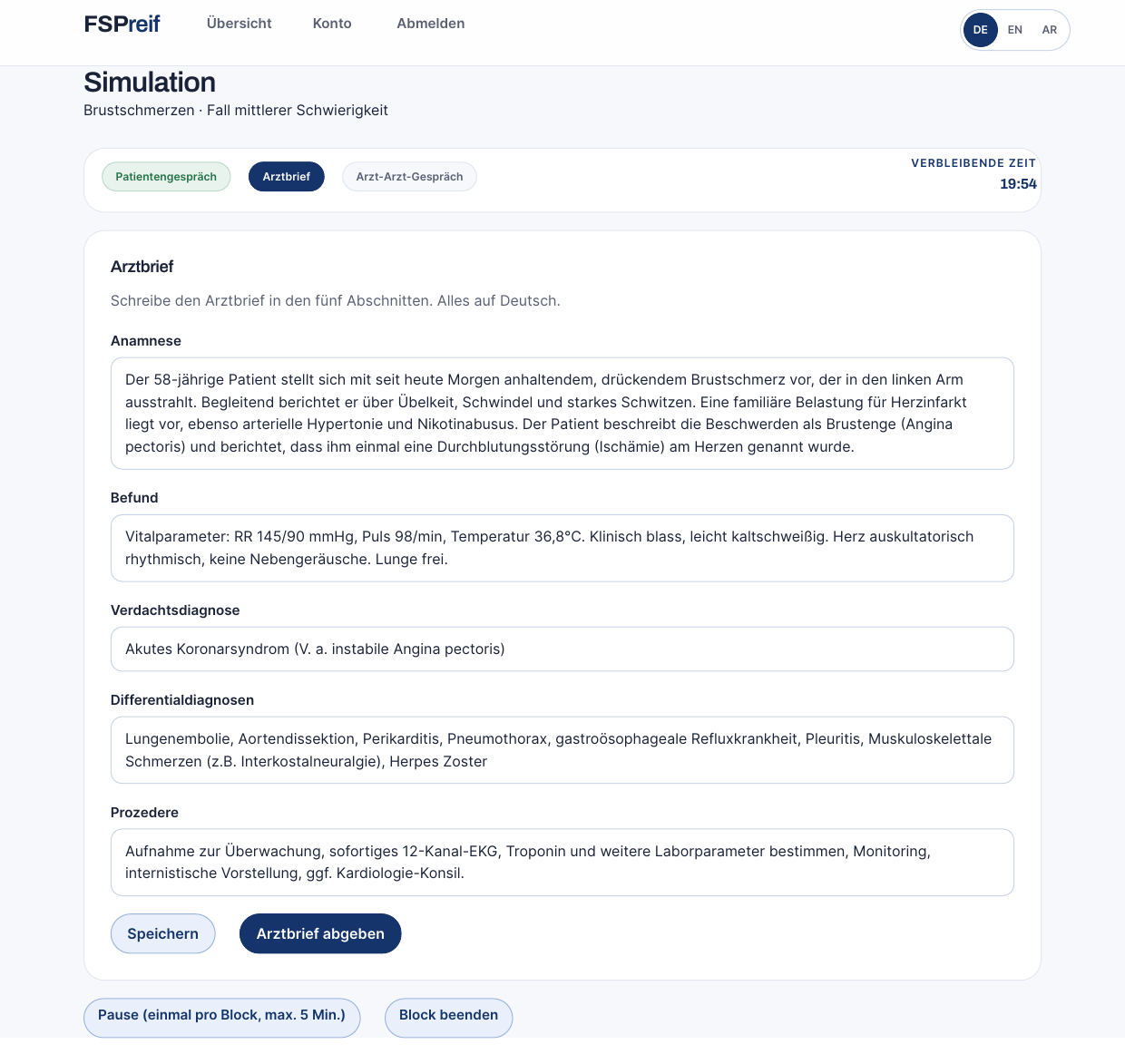
Five sections and 20 minutes on the server clock. Save as you write and submit at the end; the report compares your text with the case model letter.
The real editor surface: the same template, the same CSS and the same worked case as in the simulation, rendered straight from the product's own code, not a redrawn mock-up.
The result
Six dimensions with a label, the critical omissions by name, and at most three concrete reasons this could go wrong. Every statement is backed by a quote from your recording: no overall grade, no percentage, just the exact places you can still fix before the exam.
Overall assessment
Six dimensions
Critical omissions
Top reason you could fail
Evidence from your recording
„Sie haben eine Hypertonie, und die Beschwerden passen zu einer Angina pectoris.“06:52
Better with a patientHypertonieBluthochdruck
Quotes, technical terms and the section names of the report stay in German in every interface language: the exam is in German, after all.
Afterwards
Each terminology finding in your report turns into a short drill. You say or type the sentence again, correctly, and the card closes. If the same mistake shows up in a later attempt, the card comes back.
You saidHypertonie(to the patient)
Patient-friendlyBluthochdruck
Sample card from a real report.
Afterwards
From the report you can redo one block on its own. Only that block is re-assessed, the report is recalculated, and it marks which parts were repeats.
If it does not work out
A failed attempt costs time and money. The figures, before you look at the prices:
2-4 months
Dates are allocated by the responsible Ärztekammer. Depending on the Kammer and how booked it is, two attempts are typically two to four months apart.
approx. €400-500
The fee falls due again for every attempt. Each Ärztekammer sets it in its own schedule of fees, depending on the Kammer it is usually in this range, and higher at some.
approx. €5,000 / month
No Fachsprachprüfung, no Approbation; no Approbation, no post as an Assistenzarzt. Starting pay is around €5,000 gross a month depending on the collective agreement and the employer. That is roughly what every month of delay is worth.
The figures come from the Ärztekammern's own schedules of fees and the clinics' collective agreements. FSPreif trains exactly the part most attempts fail on: the language at the bedside.
Pricing
€79 for 12 months from purchase: 30 cases, five complete AI simulations per day and personalised AI feedback after every attempt.
Please enter a valid email address.
Without this confirmation, access cannot start before the 14-day withdrawal period ends.
Please choose an access period.
The payment could not be started. Please try again.
The payment was cancelled. Nothing was charged.
€79
Offer until 7 November, then €149
One-time payment, no subscription
12 months of access from purchase
One-off payment. No subscription, no automatic renewal, nothing to cancel.
One complete simulation on the demo case, with the complete report. All it takes is an account with a verified email address, no card.
Drill cards and your history come with paid access.
Bundesländer
Train the three 20-minute main parts with your chosen medical chamber format. Hessen adds a 20-minute vocabulary test before the patient interview.
The fee, registration and dates are set by each state medical chamber. We have researched and sourced them for all 16 Bundesländer.
Choose your medical chamber’s simulation format: seven published chamber formats with 20 minutes per main part; Hessen starts with an additional vocabulary test.
Choose Bayern, Nordrhein, Westfalen-Lippe, Baden-Württemberg, Niedersachsen, Hessen or Berlin in training.
All sixteen states are covered now. Something missing, or a fee that has changed? write to us through the contact form.
First simulation
Three blocks, an AI patient, the full report with quoted evidence from your own conversation. All you need is an account with a confirmed email address.
Start for free I already have an account
Not included in the free attempt: training cards and history.
Questions